

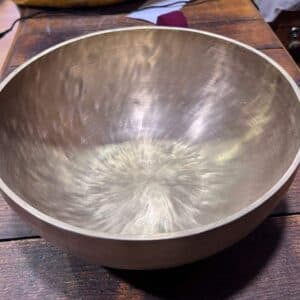
Most singing bowls live in meditation rooms or therapy studios, but a bowl is just as potent on your own mat at home. A ten-minute sitting practice with a single singing bowl is the easiest way to begin, and it becomes a habit far faster than most people expect.
Here is how to do it.
Getting ready for a singing bowl meditation
Before you strike the bowl, the space around you matters less than the space inside you.
Find a quiet moment. You do not need silence—the early morning, when most of the household is still asleep, is ideal. The 7 AM class at Rising Lotus centres on this principle: the day has not yet filled your mind. Even ten minutes before breakfast, when your attention is still fresh, will work.
Sit somewhere you will not be disturbed for ten minutes. If you have a meditation cushion, use it. If not, a regular pillow will do. The point is that your hips are slightly higher than your knees, which takes strain off the lower back and makes it easier to sit upright for the whole practice.
Sit cross-legged or in any position where your spine is straight but not rigid. Your shoulders should be relaxed, not braced. Your hands rest on your thighs or in your lap. You are not performing; you are settling. Most people find that the physical steadiness makes attention steadier too.
The first strike
Place your bowl on its ring cushion or on a folded cloth in front of you, within arm's reach. Hold your mallet gently, almost as if it weighs nothing.
Strike the bowl once, softly, near the rim. This is not a crack: a gentle tap that makes a clear sound but not a loud one.
Now put the mallet down and listen. Count silently if it helps, but mostly just pay attention to how the sound changes as it fades. A good therapy bowl will carry for thirty, forty, sometimes sixty seconds. Watch the sound the way you might watch someone walk into the distance—not grabbing at it, just following until it is gone.
This is the core of the singing bowl meditation practice. The sound is your one job. When your mind wanders, which it will, the fade of the sound is always there to return to. You do not need to judge yourself for wandering. The moment you notice that your mind has drifted, that noticing is the work. Bring your attention back to what the sound is doing now.
Rimming: the second note
When the sound has faded completely, take the mallet again. This time, instead of striking, you will make the bowl sing by running the mallet around the rim.
Hold the mallet like a pen and press it firmly against the outside of the rim at the bowl's widest part. Circle slowly and steadily, pressing the same way you would draw a line. The bowl will begin to vibrate and sing—a sustained note, often higher than the struck tone. This is the second voice of a hand-hammered bowl, and it is the main event of a singing bowl meditation session.